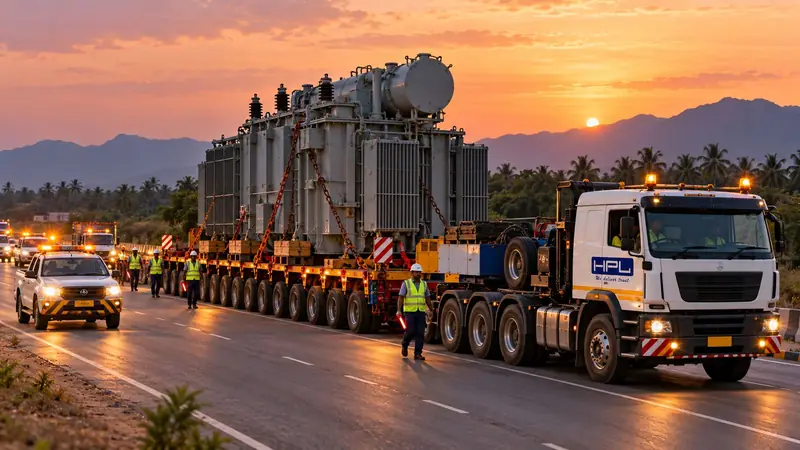
ODC (over-dimensional cargo) is any load that is wider, taller, longer or heavier than a normal truck can legally carry, such as turbines, transformers, boilers and large machines. Moving it needs the right trailer (low-bed, semi-low-bed or hydraulic multi-axle), a route survey to check bridges, cables and turns, permits from the authorities along the route, and often an escort vehicle. E-way bills for ODC get 1 day of validity per 20 km.
- ODC needs special trailers, permits and a planned route.
- A route survey checks bridge heights, cables, turns and road strength.
- Share exact dimensions, weight and lifting points before quoting.
- ODC e-way bills are valid for 1 day per 20 km.
What counts as ODC
Road vehicles in India have legal limits on width, height, length and axle weight. Any load that goes beyond these limits when loaded is treated as over-dimensional cargo (ODC), also called over-dimensional consignment or project cargo. Typical examples:
- Power plant turbines, generators and transformers
- Boilers, pressure vessels and heat exchangers
- Earth movers, cranes and construction equipment
- Wind turbine blades and towers
- Large factory machines and fabricated structures
Trailers used for ODC
| Trailer | Used for |
|---|---|
| Low-bed trailer | Tall, heavy machines, because the low deck keeps the total height down |
| Semi-low-bed trailer | Heavy machinery and earth movers that are not too tall |
| Hydraulic multi-axle modular trailer | Very heavy loads; axles can be added and each axle adjusts height |
| Extendable trailer | Long items such as blades, girders and pipes |
Why a route survey comes first
Before an ODC move, the route is surveyed to check:
- Heights of bridges, flyovers, toll canopies and overhead cables
- Bridge and culvert strength for the total weight
- Sharp turns, narrow village roads and roundabouts
- Road works and diversions along the way
Sometimes the shortest route is not possible, and the truck must take a longer path that clears every obstacle.
Permits and escorts
ODC moves need permission from the transport and highway authorities, and in some places the police, for the states the load passes through. Large loads may need a pilot or escort vehicle, and many cities allow ODC movement only at night. Getting permits takes time, so plan ODC dispatches well ahead of your deadline.
E-way bill for ODC
For over-dimensional cargo, an e-way bill is valid for 1 day for every 20 km, compared with 200 km for normal cargo. This reflects how slowly these loads move. Read more in our e-way bill guide.
What to prepare as a shipper
- Exact dimensions (length, width, height) and weight of the load, ideally with drawings.
- Lifting points and centre of gravity, so it can be loaded and lashed safely.
- Crane or lifting arrangement at both the loading and unloading points.
- Site access details: gate width, turning space, overhead obstructions.
- Your required delivery date, so permits and surveys can be planned.
- Transit insurance for the declared value.
ODC moves with HP Logistics
We arrange low-bed, semi-low-bed and hydraulic multi-axle trailers, plan the route, help with permits and escorts, and track the load throughout. Share the drawings and dimensions with us on WhatsApp at +91 93440 06789 for a planned quote.
Frequently asked questions
What is ODC in transport?
Do ODC loads need permits?
How long is an e-way bill valid for ODC?