
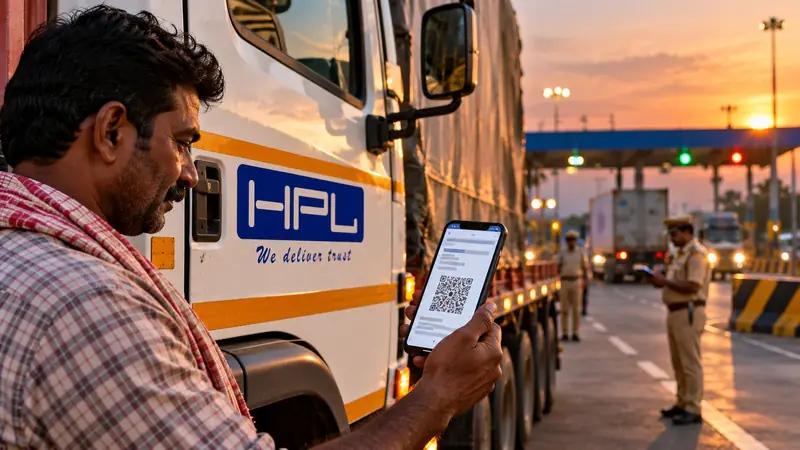
You need an e-way bill to move goods worth more than ₹50,000 in one consignment (some states set their own limit for movement within the state). Since 1 January 2025, you cannot generate an e-way bill on an invoice older than 180 days, and extensions are capped at 360 days from generation. Since 1 April 2025, every user must log in with an OTP (two-factor authentication).
- E-way bill is needed for consignments above ₹50,000 in value.
- Part A has invoice and party details; Part B has the vehicle number. Validity starts only when Part B is filled.
- Normal cargo gets 1 day per 200 km; over-dimensional cargo gets 1 day per 20 km.
- Invoices older than 180 days cannot be used, and OTP login is mandatory for everyone.
What is an e-way bill?
An e-way bill is an electronic document generated on the GST portal before goods are moved. It tells the tax department what is being moved, from whom, to whom, and in which vehicle. Officers on the highway can check it at any time.
When do you need one?
You need an e-way bill when the value of goods in a single consignment is more than ₹50,000. This applies to sales, branch transfers, job work and most other movements. For movement within a state, some states set a different limit, so check your state's rule.
A few goods are exempt, and very short movements in some cases are too, but for most factory dispatches, assume an e-way bill is needed.
Part A and Part B
| Part | What it contains | Who usually fills it |
|---|---|---|
| Part A | GSTIN of supplier and recipient, delivery PIN code, invoice number and date, value of goods, HSN code, reason for transport | The consignor (supplier) |
| Part B | Vehicle number (or transport document number for rail or air) | The consignor or the transporter |
The e-way bill becomes valid for movement only when Part B is filled. If the truck changes on the way, for example after a breakdown, Part B must be updated with the new vehicle number.
How long is an e-way bill valid?
| Type of cargo | Validity |
|---|---|
| Normal cargo | 1 day for every 200 km (or part of it) |
| Over-dimensional cargo (ODC) | 1 day for every 20 km (or part of it) |
A "day" ends at midnight following the time of generation. So a Coimbatore to Delhi load of about 2,450 km gets around 13 days of validity, which is usually enough. If the truck is delayed, the validity can be extended around the time it expires.
The 2025 changes that still matter in 2026
- 180-day invoice limit (from 1 January 2025). You cannot generate an e-way bill on an invoice, delivery challan or other document dated more than 180 days ago.
- 360-day extension cap (from 1 January 2025). An e-way bill can be extended, but not beyond 360 days from the day it was first generated.
- OTP login for everyone (from 1 April 2025). Two-factor authentication became mandatory for all users. Make sure the mobile number registered with your GSTIN is current, or your team will be stuck at login.
- E-Way Bill 2.0 portal (from 1 July 2025). A second portal, ewaybill2.gst.gov.in, works alongside the original one and keeps data in sync. If one portal is slow, you can use the other.
Common mistakes that stop trucks on the highway
- Wrong or old vehicle number in Part B, especially after a truck change.
- Validity expired because of a breakdown or a long stop, and not extended in time.
- Invoice value, quantity or HSN code not matching the goods on the truck.
- One e-way bill used for two invoices. Each invoice needs its own e-way bill.
- Goods moved before Part B was filled.
When this happens, officers can detain the vehicle and goods, and the penalty can be heavy. A few minutes of checking at dispatch saves days of delay.
A simple checklist before your truck leaves
- Invoice date is within 180 days.
- Part A details match the invoice exactly.
- Part B has the correct vehicle number of the truck actually being loaded.
- Distance entered is realistic, so the validity is enough for the route.
- Driver has the e-way bill number or a printout, along with the invoice and LR.
How HP Logistics helps
When you book with us, our team checks your e-way bill against the invoice and the vehicle before loading. If the vehicle changes on the way, we update Part B so the truck keeps moving. And because every truck is tracked, we can extend validity before it runs out if there is a delay.
This is a general guide, not legal or tax advice. Thresholds and procedures can change, so please confirm specifics with your chartered accountant or the official GST portal.
Frequently asked questions
What is the e-way bill limit in 2026?
Can I generate an e-way bill for an old invoice?
How many days is an e-way bill valid for 1,000 km?
What happens if the truck changes during the trip?